


The Power of Mental Health Peer Support: Finding Strength Together
- Jul 23
- 8 min read

You Don't Have to Explain Yourself: What Peer Support for Mental Health Actually Looks Like
If you're struggling with your mental health right now — whether that's depression, anxiety, PTSD, or just the crushing weight of a life that keeps getting harder — you don't have to walk into a room full of strangers and perform your pain to get help.
You don't have to say the right words. You don't have to know the right diagnosis. You don't have to convince anyone that what you're going through is real.
Peer support isn't about convincing anyone of anything. It's about connecting with someone who already knows — because they've been there themselves.
If you're in Modesto, Stockton, Merced, or anywhere in California's Central Valley, this kind of support exists. And it may be available to you for free.
What Is Mental Health Peer Support?
Mental health peer support is help from someone who has lived experience with mental health struggles — not a professional looking at a clipboard, but a real person who has felt what you're feeling and found a way through.
A peer support specialist — someone who has been through it themselves and gets it — can sit with you, help you make sense of things, and walk alongside you as you figure out next steps. They're not there to diagnose you or tell you what to do. They're there to help you find your own footing.
This kind of support can happen in a group setting, one-on-one, over the phone, or through community programs. It's flexible by design — because life doesn't stop being hard just because you can't make it to an appointment.
How Is Peer Support Different From Therapy?
Both matter. But they're different kinds of help.
Therapy is clinical. A licensed therapist is trained to diagnose conditions, provide treatment, and work within a medical model. That kind of care is valuable — and if you need it, we want to help you find it.
Peer support is something else entirely. It's human connection grounded in shared experience. It doesn't replace clinical care — it fills the gaps that clinical care can't reach.
When someone is afraid to walk through a clinic door — because of past trauma, distrust, shame, or just not knowing what to say — a peer can be the bridge. We think of it as meeting people where they are, not where the system wishes they were.
Why Mental Health Feels So Hard to Talk About in
the Central Valley
If you've ever felt like asking for mental health help was a sign of weakness, you're not alone in that feeling — but it's not true.
Here in the Central Valley, there are real, specific reasons why mental health support is hard to access and hard to talk about:
Stigma runs deep. In many communities here — including agricultural, Latino, immigrant, and faith-based communities — mental health struggles are still seen as something you handle privately. Admitting you're struggling can feel like letting your family down.
Resources are stretched thin. The Central Valley has some of the highest poverty rates in California and some of the lowest concentrations of mental health providers. Appointments can take weeks or months to get.
Transportation is a real barrier. If you don't have a car or can't afford gas, getting to a clinic across town feels impossible — especially if you're already barely holding it together.
The heat is brutal. Extreme summer temperatures in this region make it physically harder to leave the house, attend appointments, or access services.
Life is complicated. For many people here, mental health doesn't exist in isolation — it's tangled up with housing instability, substance use, chronic illness, and trauma. Getting help with just one piece of that puzzle doesn't always feel like enough.
We understand this because we live and work here too. Our team isn't made up of people from outside the region looking in. We're part of this community.
Real Barriers — And What Peer Support Does About Them
Shame and Stigma
You might have grown up being told to push through. To not let people see you struggling. To handle it on your own.
A peer support specialist doesn't see your struggles as weakness. They see them as weight — real weight that you've been carrying, probably for a long time. When you talk to someone who has carried something similar, you don't have to spend the whole conversation justifying that it's heavy.
Isolation
One of the cruelest things about mental health struggles is that they make you pull back from people — exactly when connection is what you need most.
We've seen it over and over: the first conversation a person has with someone who truly understands them can shift something. It doesn't fix everything. But it breaks through the silence.
Not Knowing Where to Start
The mental health system can feel like a maze with no entrance. Do you call your insurance? Do you go to the ER? Do you just wait until things get worse?
A peer who has navigated that same system — in this same region — can help you figure out what your first step is. Not a generic list of numbers to call, but a real conversation about what makes sense for your situation.
If you're not sure where to start, you can complete our free Total Resource Check-In and we'll help you figure out what's available to you.
Feeling Like the System Wasn't Built for You
If you've had experiences with healthcare, social services, or mental health systems that felt dehumanizing, dismissive, or just unhelpful — that distrust is earned. You're not wrong to be cautious.
What makes peer support different is that it's not the system. It's people who've been through the system — the same system that let them down too — and came out the other side wanting to help others do the same.
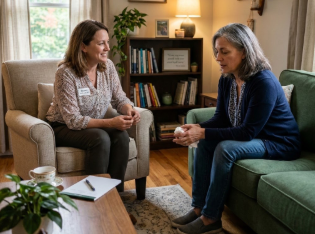
What Peer Support Actually Looks Like (Day to Day)
This isn't an abstract concept. Here's what peer support for mental health can actually look like in real life:
Sitting with someone and talking through what's been going on — without being evaluated or judged
Getting help figuring out what kind of care you need and how to ask for it
Having someone help you prepare for a doctor or clinic appointment so you actually get what you came for
Being connected to housing help, food assistance, or other support when mental health is part of a bigger picture
Checking in regularly so you don't fall through the cracks between appointments
Helping you understand your rights and how to speak up for yourself in a medical setting
This is what we mean when we say peer support meets you where you are. It's practical. It's flexible.
And it's rooted in the belief that you are the expert on your own life — you just might need someone to help you navigate.
Who Can Benefit From Peer Support for Mental Health?
Peer support can help you if:
You're dealing with depression, anxiety, PTSD, bipolar disorder, schizophrenia, or any condition that's making it hard to function
You've been struggling for a while but haven't been able to get consistent care
You feel like things are spiraling and don't know how to stop it
You're recovering from substance use and also dealing with mental health challenges
You've been through trauma — childhood, domestic violence, incarceration, loss — and it's affecting your life today
You feel like no one in your life really understands what you're going through
You're on Medi-Cal and didn't know that extra support might be available to you at no cost
You don't need to have a diagnosis. You don't need to hit a crisis point before you deserve help. If life is hard and your mental health is suffering, that's enough.
What If I Have More Than One Thing Going On?
Most people do.
Mental health rarely shows up by itself. It shows up alongside housing instability, addiction, chronic illness, financial stress, domestic violence, justice involvement, and a hundred other things that the world doesn't make easier.
The good news: that's exactly what peer support is designed for. We don't ask you to pick one thing to get help with. We start with the whole picture of your life and figure out what actually needs to come first.
If you're on Medi-Cal and dealing with serious mental health challenges — especially if you're also facing housing instability, substance use issues, or frequent ER visits — you may qualify for a deeper level of free support through your Medi-Cal coverage. This can include a dedicated support person who stays with you through the whole process, not just one visit.
Find out what you may qualify for by completing the Total Resource Check-In. It takes about 10–15 minutes and you'll hear back within 72 hours.
How to Get Peer Support in the Central Valley — Starting Today
You don't need to call anyone. You don't need to explain yourself to a front desk. You don't need to be in crisis.
Here's how to take the first step:
Go to helpishope.org/resources.
Fill out the Total Resource Check-In. Answer honestly. There are no wrong answers — the more you share, the more we can help.
Wait for your personalized resource guide. Most people hear back within 72 hours.
Connect with our team for follow-up peer support. If you want someone to walk through next steps with you, we're here.
That's it. No phone maze. No insurance pre-authorization. No appointment three weeks from now. Just a first step that you can take right now, from your phone, wherever you are.
You Are Not Broken. You Are Not Alone.
Mental health struggles are not a character flaw. They're not proof that you're weak or that something is fundamentally wrong with you. They're part of being human — especially when life has been consistently hard.
Here in the Central Valley, too many people carry their pain in silence because they don't know help exists, don't believe they deserve it, or have tried before and been let down.
We're not here to hand you a pamphlet and send you home. We're here because people on our own team have been through it. We know what it's like to feel like the system wasn't built for you — and we built something different.
You deserve support that actually understands your life. You deserve someone in your corner.
Frequently Asked Questions
What is peer support for mental health?
Peer support for mental health means getting help from someone who has personally lived through mental health challenges. They're not a therapist or doctor — they're a real person who has been through it and wants to help you find your way through it too. It's based on connection, shared experience, and practical help navigating what comes next.
Is peer support the same as therapy?
No. Therapy is clinical care provided by a licensed professional. Peer support is human connection from someone with lived experience. Both have value, but peer support is often more accessible, less intimidating, and can help you get ready to access clinical care if that's what you need.
Is peer support free in the Central Valley?
It can be. If you have Medi-Cal and qualify for enhanced support through your plan, peer support and care coordination services may be fully covered — at no cost to you. Complete our free Total Resource Check-In to find out if you qualify.
Do I need a diagnosis to get peer support?
No. You don't need a formal diagnosis. If you're struggling with your mental health and life feels overwhelming, that's enough. We start with where you are, not what's on a piece of paper.
What if I'm also dealing with housing issues or substance use?
That's very common, and it's exactly what we're here to help with. Mental health, housing, and substance use challenges often overlap — especially here in the Central Valley. Peer support can help you address all of it, not just one piece.
How do I get started?
Go to our resources page and fill out the Total Resource Check-In. It's free, takes about 10–15 minutes, and you'll get a personalized response within 72 hours.
What if I don't have a phone or email?
The intake form asks for contact information to send your resource guide. If you have access to email through a library, shelter, or someone you trust, that works.
What if I'm in crisis right now?
If you are in immediate danger, please call 911 or go to your nearest emergency room. For mental health crises, you can call or text 988 (Suicide and Crisis Lifeline) — it's available 24/7.

Comments