


How to Build Healthy Daily Routines That Actually Stick (Even When Life Is Hard)
- Jun 30
- 7 min read

Most people don't fail at healthy habits because they're lazy. They fail because life — real life — keeps getting in the way.
Bills pile up. Appointments overlap. You're tired. You're stressed. And suddenly the routine you built falls apart before it even had a chance.
You're not alone in that. And you don't have to start over from scratch every time. We've seen what actually works for people in Modesto, Stockton, Merced, and across the Central Valley — and it's not perfection. It's small steps done consistently, with the right support behind them.
If you want help figuring out what kind of support might be available to you — for free — check out our resources page and fill out the Total Resource Check-In. It takes about five minutes.
Why Routines Are So Hard to Keep (You're Not the Problem)
Here's something important to understand before we go any further: if you've tried to build healthy habits and failed, that is not a character flaw.
The Central Valley has one of the highest poverty rates in California. Extreme heat in summer, limited transportation, and gaps in rural services make everyday health tasks harder here than in other parts of the state. When you're in survival mode — focused on keeping a roof over your head, feeding your family, managing a health condition — there's very little energy left for "building habits."
That's just the reality. And any advice that ignores that reality isn't actually useful.
What we're sharing here is built for real life — not for someone with a quiet schedule and no stress. If something in this guide doesn't fit your situation right now, that's okay. Start where you can.
Why Simple Routines Change Everything
When people try to overhaul their health all at once, they almost always burn out. It's too much, too fast, and when one thing slips, the whole thing collapses.
Simple routines work differently. They focus on small, repeatable actions that fit into your life instead of replacing it.
Here's what building a simple routine can do for you:
Reduce mental load — when a task is part of a routine, you don't have to spend energy deciding to do it
Build real confidence — completing small things consistently reminds you that you can follow through
Create stability — even when your housing, schedule, or health feels unstable, a routine gives you something solid
Make bigger changes possible — small habits are the foundation that harder goals get built on
For example: instead of committing to "eating healthy," start by adding one piece of fruit to your day. Instead of "exercising more," take a 10-minute walk after dinner three times a week.
These aren't small because they're easy. They're small because they're real. We help people in the Central Valley build this kind of practical, whole-person support. You don't have to do this alone.
How to Build a Routine That Sticks
Start with Your Priorities
Before anything else, ask yourself: what are the most important health tasks I need to stay on top of?
For many people, that list includes:
Taking medications on time
Keeping or preparing for doctor's appointments
Following up on care instructions after a visit
Eating regularly, even when money is tight
Getting a little movement in when possible
Write these down. Even a short list on paper gives you something to work from. If you want help figuring out what's most urgent in your situation, book a free appointment with one of our peer support specialists — a real person who has been through it themselves.
Choose One Small Habit First
This is where most people go wrong: they try to do everything at once. Pick one habit to start. Just one.
Here are some examples that have worked for people we've worked with:
"I take my medicine right after brushing my teeth in the morning."
"I drink a glass of water as soon as I wake up."
"I check the calendar for my next appointment every Sunday."
Being specific about when and where you'll do something makes it much easier to actually do it. "I'll eat better" is too vague. "I'll put a banana on the counter the night before" is something you can actually do.
Use Reminders You'll Actually See
Your brain is not the most reliable reminder system — especially when you're dealing with stress, pain, or a lot going on.
Use what works for you:
Phone alarms — set them with a label like "take pill after brush"
Sticky notes — on the fridge, mirror, or front door
A simple paper calendar — mark off each day you complete your habit
A pill organizer — fill it once a week so you never guess whether you took something
The goal is to reduce the mental effort of remembering. Make your environment do the work for you.
Practice at the Same Time Every Day
Habits form through repetition. The more consistently you do something at the same time and in the same place, the less you have to think about doing it.
It starts to feel automatic — and that's exactly the goal.
This doesn't mean you can't miss a day. You will miss days. Everyone does. When that happens, the most important thing is not to interpret one missed day as failure. Just start again the next day, without shame.
If you're dealing with mental health challenges, trauma, or substance use recovery that makes consistency hard, we offer free support specifically for those situations. You deserve help that understands the whole picture.
Adjust When Life Changes
A good routine isn't rigid. It bends with you. If your schedule changes, if you move, if you get sick, if something breaks down — your routine may need to shift too. That's not failure. That's just life.
The key is to look at what stopped working and ask: what would make this easier right now?
A different time of day?
A different reminder?
A simpler version of the same habit?
Small adjustments keep routines alive. Our team can help you problem-solve when life changes — whether that's a new health situation, a housing move, or a shift in your daily schedule.
Real-Life Routine Examples That Work
Here are simple routines built around common health challenges. These aren't ideal scenarios — they're designed for real life in the Central Valley.
Medication Routine: Take your pill right after a daily habit — brushing teeth or eating breakfast. Use a pill organizer and a phone alarm with a label. That's it.
Appointment Preparation: The night before a doctor's visit, gather your medications, ID, insurance card, and any questions you have. Put them in a bag by the door so you're not scrambling in the morning.
Follow-Up After a Visit: Right after an appointment, set a reminder for any next steps — blood work, a prescription pickup, a follow-up call. Don't wait until you get home and forget.
Healthy Eating on a Tight Budget: Start with one change: keep a piece of fruit or pre-cut vegetables somewhere visible. Visible food gets eaten. Hidden food gets forgotten.
Movement: A 10-minute walk after lunch or dinner — especially in the morning or evening when the Central Valley heat isn't at its worst — is a real, sustainable start.
We work with people navigating basic needs, health, and daily life challenges every day. If you're not sure where to start, that's what we're here for.
How Having a Helper Makes All the Difference
Knowing what to do and actually doing it are two completely different things.
When life is overwhelming — when you're dealing with housing instability, chronic illness, mental health challenges, or just the weight of not having enough — motivation alone doesn't work. You need someone in your corner.
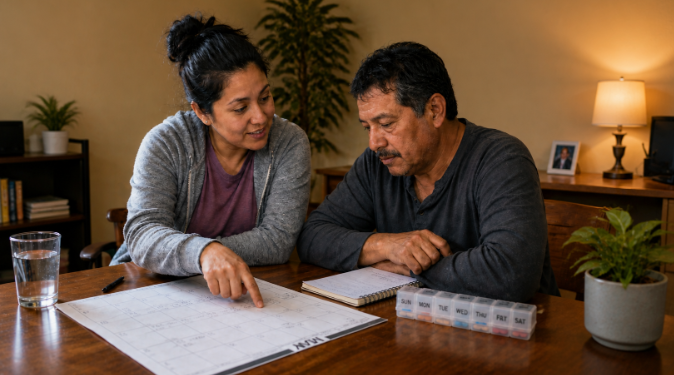
Our helpers are Peer Support Specialist and Community Health Workers — real people who have been through hard things themselves. They understand what it feels like to try to hold everything together when the system wasn't built for you.
Our team can:
Work with you to build routines around your appointments, medications, and follow-up care
Help you practice the habit and check in when you've been off track
Adjust your routine when your situation changes — a move, a new diagnosis, a change in insurance
Provide encouragement when you feel like giving up — not lectures, just real human support
This kind of support may be completely free for people who qualify through Medi-Cal or Medicare. If you have Medi-Cal and you're dealing with a health condition, housing stress, mental health challenges, or substance use recovery, you may already be eligible. Visit our resources page to find out.
Tips to Keep Your Routine Going
Celebrate the small wins. Finished your routine three days in a row? That counts. Acknowledge it.
Share your goal with one person. Accountability doesn't need to be formal. Telling someone you trust makes it more real.
Be kind to yourself when you miss a day. Missing once does not erase progress. Just start again tomorrow.
Review weekly. Every Sunday or Monday, take two minutes to ask: what worked? What didn't? What needs to change?
Use tools that actually work for your life — apps, paper lists, sticky notes, phone alarms, whatever is realistic for you
Connect with support when you're struggling. That's not weakness — that's strategy. We're here when you need it.
Frequently Asked Questions
What if I don't have a regular schedule?
Routines don't require a perfect schedule. Anchor your habit to something you already do every day — waking up, eating, brushing your teeth. Use that as your trigger, not the clock.
What if I forget most of the time?
That's normal, especially in the beginning. Add a visual reminder — a sticky note, a phone alarm, a pill organizer on the counter. The goal is to make the reminder unavoidable.
What if my health or housing situation keeps changing?
Routines need to adapt. When something changes, ask: what's the simplest version of this habit I can still do right now? Don't abandon the whole thing — shrink it until it fits.
Is there free help available for people in the Central Valley?
Yes. If you have Medi-Cal, you may qualify for free one-on-one support from someone who can help you build and maintain healthy routines — plus connect you to housing, food, mental health care, and more. Start at our resources page. It takes about five minutes.
What if I have a chronic illness and routines feel impossible?
Chronic illness, pain, and fatigue make consistency harder — but also make it more important. A helper who understands your health situation can work with your limitations, not against them. Book a free appointment to talk it through.

