


You Don't Have to Feel Left Behind: Digital Skills for Adults in the Central Valley
- Jun 26
- 7 min read

Maybe technology has always felt like something for other people. Maybe you've never owned a smartphone, or you have one but it mostly sits in a drawer. Maybe you've tried to apply for a job or schedule a doctor's visit online and just stopped because it felt impossible.
You are not behind. You are not broken. And you are not alone.
Across Modesto, Stockton, Fresno, and the wider San Joaquin Valley, thousands of adults are navigating the same wall. And here's what most people don't know: there is real, free, peer-led help available — from people who have been through exactly what you're going through.
If you're ready to find out what's available for you, start with our free resource check-in at helpishope.org/resources — and someone from our team will follow up personally.
What Digital Literacy Actually Means (In Plain English)
"Digital literacy" sounds like a fancy term. It just means knowing how to use a phone or computer to do everyday things — things that used to require a phone call, a bus ride, or a paper form.
It includes things like:
Searching for information online (like "free food near me" or "how to apply for CalFresh")
Sending a text or email
Using a phone or tablet to schedule a medical appointment
Filling out a job application online
Accessing your benefits, test results, or case files through a secure website
Staying connected with family through video calls
None of these skills require a college degree. They don't require you to be "good with technology." They just require a little practice, a little patience, and the right support — which is exactly what we're here to help you find.
Why This Matters More in the Central Valley
This isn't a problem that happens equally everywhere. In the Central Valley, the digital divide hits harder — and it hits people who are already dealing with the most.
Here's the reality:
Fresno County has one of the highest poverty rates in the state
Rural areas around Modesto, Merced, and the San Joaquin Valley have limited public Wi-Fi and fewer in-person tech resources
Extreme heat makes it dangerous to travel long distances to access computers at libraries
Many agricultural and seasonal workers have inconsistent income, making phone plans and data difficult to maintain
People in shelters or transitional housing often have limited or no private device access
When a housing application is only online, and you don't have a device or know how to use one, you're not just inconvenienced — you can lose your spot on a waiting list. When a job posting says "apply at" and there's no phone option, you're not just frustrated — you might go without income for another week.
These aren't small problems. They're survival problems. And we believe everyone deserves access to basic needs — including digital access.
The Real Barriers — and Why They're Not Your Fault
Before we talk about what you can do, let's name what you might be up against. Because pretending the barriers don't exist doesn't help anyone.
No Device or Internet Access
Not having a smartphone, tablet, or computer is the most common barrier — and it's completely outside your control if you don't have income to buy one. Many people in the Central Valley also lack reliable home internet or data. If this is where you are right now, connect with us through our My Needs support page — we can help explore options for getting you connected.
Fear of Making Mistakes
One of the most common things we hear is "I'm scared I'm going to break something" or "I don't want to look stupid." That fear is real and valid. Technology can feel unpredictable, especially when the stakes are high — like applying for housing or healthcare. But here's the truth: you can't break the internet by clicking the wrong thing. The learning process is safe, and we walk through it with you at your pace.
Low Literacy or Language Barriers
If reading is a challenge — in English or any language — that doesn't have to stop you. Many digital tools today use images, voice commands, and audio. Our team includes people who have navigated language barriers themselves, and we work with you where you are. Visit our resources page to connect with someone who understands.
Mental Health or Physical Challenges
If anxiety, depression, PTSD, or a physical disability makes it hard to focus or sit at a screen, we see that too. Learning new things is harder when you're already carrying a lot. You don't have to push through alone. Our My Mind and My Body support services are here to help with the whole picture — not just the tech piece.
What You Can Actually Do With Basic Digital Skills
Here's a concrete picture of what changes when you build even a few basic skills:
Without Digital Skills | With Basic Digital Skills |
Miss healthcare appointments because you can't schedule online | Book and manage appointments from your phone |
Lose job opportunities because applications are online-only | Apply for jobs any time, from anywhere |
Wait in long lines at benefit offices | Check your case status and renew CalFresh online |
Feel isolated without access to family or community | Stay connected through free video calls and messages |
Miss emergency alerts during extreme heat or floods | Receive real-time safety alerts on your phone |
Rely on others to look things up for you | Find information independently, at any hour |
These aren't luxuries. In 2026, digital access is a basic need — the same way food and shelter are. And we treat it that way.
How We Help You Build These Skills
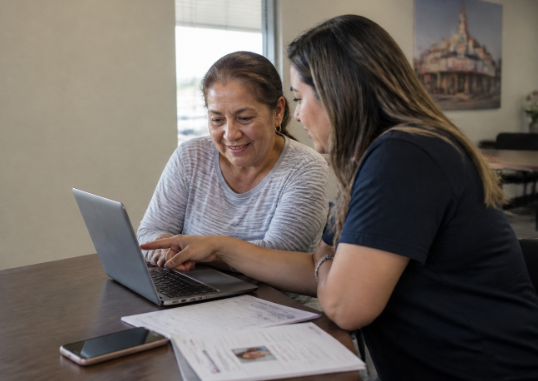
We offer free, peer-led support for people who want to build their digital confidence. "Peer-led" means you're working with real people who have been through hard things themselves — not a teacher who has never gone without, not a corporate trainer, not a chatbot.
Here's what working with us can look like:
One-on-one support from someone who sits with you and walks through the basics without judgment
Help finding a device or internet access if you don't currently have one
Guided practice on real tasks — like filling out a benefits form, sending an email, or finding local resources online
Ongoing check-ins so you don't feel like you learned something once and then got abandoned
Connection to other services if digital skills are part of a bigger picture — like job searching, healthcare, or housing
You can book a one-on-one support session with our team. It's free. No application required. Just show up as you are.
Taking the First Step (It's Smaller Than You Think)
You don't have to commit to a class. You don't have to have a device already. You don't have to know what you're doing.
Here's all you need to do right now:
Fill out our free Total Resource Check-In. It takes about 10 minutes and tells us what kind of support might help you most.
Or book a direct appointment if you'd rather just talk to someone first.
Tell us where you're starting. No device? We'll figure out a next step. No internet? Same. Just overwhelmed? That's a completely valid starting point.
We don't need you to have your act together before you reach out. That's kind of the whole point. If you're in Modesto or anywhere in the Central Valley and you've been putting this off, let this be the moment you stop waiting. Start here at our free resources page — that's where we begin.
You're Not Behind — You're Just Getting Started
There's no rule that says you had to learn this by now. Technology changes fast, and the systems that are supposed to help people often make it harder — not easier — to keep up.
What we know is this: the people who reach out, who take one small step, who let someone else help them figure it out — they move forward. Not because they figured everything out on their own. But because they let someone walk with them.
We're here for that. Real people. No judgment. No waitlist to get basic support.
Start your free check-in — and let's figure out your next step together.
Frequently Asked Questions:
What if I don't have a phone or computer?
That's actually where we often start. When you connect with our team, we can help explore options for getting you access to a device or internet — not just teach you how to use one you don't have.
Do I have to be on Medi-Cal to get help?
No. Our peer support services are available to adults in the Central Valley regardless of insurance. If you do have Medi-Cal, you may qualify for additional free support through programs that can cover things like care coordination, transportation, and housing help. Find out what you may qualify for.
I'm older and I feel like it's too late for me to learn this stuff. Is it?
Absolutely not. We work with adults of all ages, including people in their 50s, 60s, and 70s who are building digital skills for the first time. Learning has no age limit — and having someone patient and supportive makes all the difference.
What if I've tried before and failed?
Then you've already taken the hardest step — trying. What's different with peer-led support is that you're not alone in it. You have someone who gets it walking beside you. Book a session and let's try again together.
Is this really free?
Yes. Our peer support and navigation services are free. We don't charge for appointments, check-ins, or resource connections. If you're worried about hidden costs, you can ask us directly when you connect.
Can you help me with more than just digital skills?
Yes — that's actually what we're built for. Digital access is often just one piece of a bigger picture. We can also connect you to support for housing and basic needs, employment and bills, mental health support, and more.

